Culture Doesn't Wait for Permission: Peers, Trust & The Ethan Hunt Addiction
Status: Declassified - File Archive 10 | Quiet Leadership, Culture Building, Trust

We’re back in the archives.
Same source as before. Carlo Ancelotti. Quiet Leadership.
A week ago, I showed you the Super Villain’s two modes — loud and quiet. The lightning rod and the deliberate restraint.
But here’s what I didn’t tell you: sometimes the quietest thing a leader can do is get out of the way entirely.
Let me confuse you. 🎯
📌 The Dot: Culture From the Dressing Room
Ancelotti shares a story about John Terry and Didier Drogba:
“John Terry was standing there telling Drogba why a particular type of behaviour was unacceptable and that is not how we did things at Chelsea.”
Then drops this:
“Cultural education can often come better from workmates rather than the boss. This is a really important lesson about building a strong dressing room.”
Read that again. Cultural education from workmates — not the boss.
The Field Reality:
Let me set the scene.
One of my SRE team members — let’s call him Peter Parker 🕷️ (protecting the kid’s identity here) — was on ROTA duty that week. As the ROTA person, he’s the first responder. When production incidents hit, he plays Incident Commander. That’s the deal.
Peter had a function outstation. That’s fine. Life happens.
But here’s the thing about ROTA ownership:
If you won’t be available during your ROTA week — including weekends — you have two options:
⚡ Option A: Delegate that ROTA duty to someone for the specific dates you won’t be available — and ensure they explicitly accept the handover
⚡ Option B: Reschedule your ROTA to a different week when you WILL be available — by negotiating with the team in advance
Peter did neither. He informed others he’d be away and expected them to cover. No explicit handover. No confirmed ownership transfer. No rescheduling.
That weekend? A production incident happened. The Incident Commander was missing.
Now here’s where the story gets real:
Aravindhan and another SRE were attending a colleague’s sister’s marriage that same weekend. They weren’t on ROTA that week.
Now, when a production incident hits, every priority comes down — even personal ones. Production incident becomes top priority for everyone. That’s non-negotiable.
But here’s the thing: the ROTA person is the first responder. The Incident Commander. He does the first-hand assessment. He pulls in the required Engineers, DevOps, and SRE to the war room based on that assessment.
That’s Peter’s job. Peter wasn’t there.
So Aravindhan — from the wedding venue — had to step up as first responder. A role that wasn’t his that week.
The person not on ROTA became the Incident Commander. The person on ROTA was missing.
That’s when the Google Chat thread lit up. 11:02 AM.
Aravindhan stepped in. Direct. Clear. No meeting needed.
“Informing is different from delegating.”
He continued:
“You cannot expect others to take ownership for YOUR ROTA delegation. The ROTA person is the first responder. If you’re unavailable, you don’t just inform — you ensure coverage is OWNED by someone, confirmed, and handed over properly. Or you reschedule your ROTA week by negotiating with the team.”
Peter pushed back, trying to explain his side.
Aravindhan held firm — but watch how he delivered it with belonging cues:
“I think me and others didn’t have clear understanding of your situation… We could have discussed better. But the principle stands: ROTA ownership cannot be abandoned.”
That’s Netflix 4A Feedback in action:
⚡ Aim to Assist — Not attacking Peter, helping him see the gap
⚡ Actionable — Clear options: delegate properly OR reschedule
⚡ Appreciate — Left room for Peter to respond
⚡ Accept or Discard — Peter’s choice what to do with it
And here’s the belonging cue that matters: Aravindhan took partial ownership too. “We could have discussed better.” He didn’t just point the finger. He held the mirror to the whole system. That’s how you give hard feedback without breaking the person.
Peter acknowledged: “Will make sure this is not repeated. Thanks.”
Then Noordeen did something powerful. He took a personal correction and expanded it into team-wide cultural education:
“This is not only for Peter.”
“When you’re on ROTA, you’re the Incident Commander. That’s not a title — that’s a responsibility. If something comes up, you have two choices: delegate with explicit handover, or reschedule your ROTA week in advance. You don’t just inform and disappear. You don’t leave your responsibilities hanging unattended.”
“@all — Let’s practice these things as well.”
11:33 AM. Done.
31 minutes. In chat. Resolved. Team learned.
At some point, Aravindhan asked Peter to reach out to him, Deepika, Noordeen, and me if he needed clarification on the feedback.
My contribution? One message:
“I guess you, Deepika and Noordeen are already a handful 🙂”
Translation: They’ve got this. I’m not needed here.
The Twist:
If I had jumped in with my Advice Monster 🐲 — the one Noordeen and Aravindhan have named — here’s what would have happened:
⚡ Multiple meetings easily spanning 3–6 hours overall
⚡ Continuous messaging for days
⚡ Peter gets defensive
⚡ Team tunes out
But when peers correct peers — peers who stepped up from a wedding to play a role that wasn’t theirs — with 4A Feedback and belonging cues? Different energy entirely.
The correction carried weight because they had earned the right to give it. They walked the talk. Then they talked.
Aravindhan and Noordeen aren’t just Tech Leads. They’re Dressing Room Leaders. Like John Terry telling Drogba how things work at Chelsea.
I’m building a dressing room. And the best sign of progress? Culture gets enforced when I’m not even in the room.
Remember in Avengers: Endgame when Tony Stark and Steve Rogers finally reconcile and start working together without Fury’s intervention? That’s dressing room culture. The team aligned itself. Fury didn’t need to be there. 🛡️
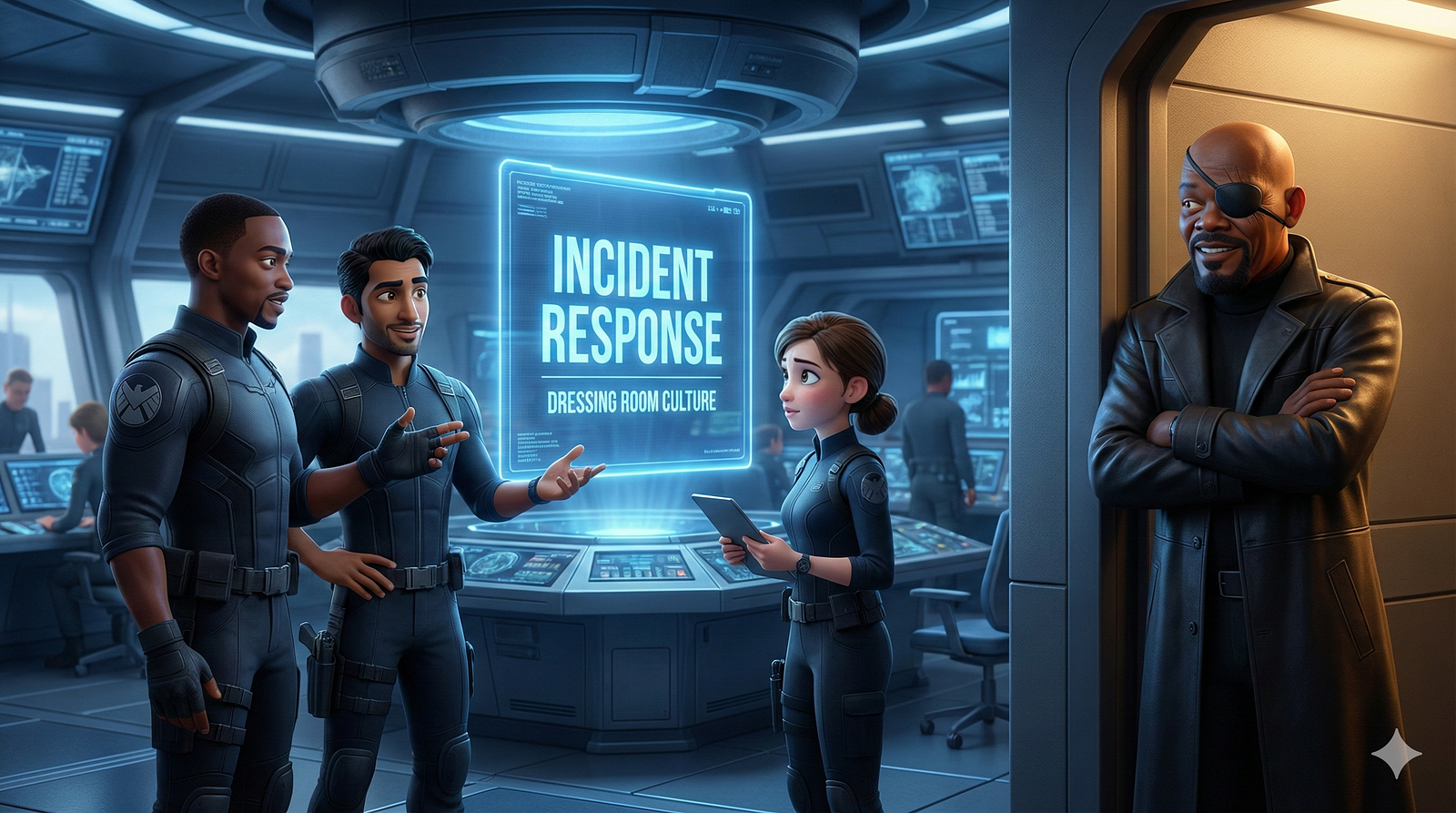
The best culture works when you’re not in the room.
📌 The Dot: Trust is Prepaid
Ancelotti on building teams:
“Working with these athletes, taking care of them and helping them develop and grow, building trust and loyalty…”
Trust. The word every leader throws around. But how do you actually build it?
The Field Reality:
Think of Monopoly. 🎲
Every player starts with money before they’ve done anything. Before they’ve bought properties. Before they’ve proven they can play.
That money is prepaid trust.
Sam Prasad taught me this. He’d throw me into missions:
⚡ Before I was ready
⚡ Before I knew it was coming
⚡ Outside my job description
“Isn’t that Admin’s job?” I’d ask.
He’d just look at me. Do it anyway.
That QA adventure — leading a team with 2 developers and 1 lawyer to build quality processes — I had no business being there. But Sam dropped me in the middle of the rough sea and believed I’d swim.
That’s prepaid trust.
The Twist:
But here’s the guardrail. Trust is prepaid, not a blank check.
Netflix calls it Freedom and Responsibility. You get the freedom upfront. But if that freedom isn’t handled with adequate responsibility — or worse, abused — additional controls come in.
The equation:
⚡ Prepaid trust + Responsibility = Growth
⚡ Prepaid trust + Abuse = Controls reinstated
When delegation fails? Learn from it. What went wrong? What went well? Recalibrate. Then:
Continue same mission (adjusted)
Pivot to different mission
Drop mission altogether
The constant? Loads of learning. Always.
Think about how Fury handed the Tesseract project to different people over the years. Some earned more trust. Some got their access revoked. But he always started by giving them the mission first — prepaid trust with accountability built in. 🛸
📌 The Dot: Managing Support Staff
Ancelotti writes about his coaching staff:
“My priority is to make sure they can operate in the way that suits them best, that they are valued and respected and that they have the opportunity to develop as coaches.”
Not micromanaged. Enabled.
The Field Reality:
Here’s my system with my Tech Leads:
Daily: Sync on strategies, execution, progress, challenges. Alignment layer.
Zephyr 3.0 1–1s: They bring 5 questions. They pick 3 for deep discussion. 2 for quick touchpoints.
The questions:
Performance: What’s going well? What’s challenging?
Peer Relationships: How’s collaboration across teams?
Leadership: Where are you showing ownership?
Innovation: What are you learning? How can we work better?
Your Topics: What’s on your mind?
They decide which three. Their agency. Their growth.
And in those sessions? I confuse them. On purpose. 🎯
Classic Thanos soul in Nick Fury personality. 😈
I give them my point of views — sometimes contradictory, sometimes incomplete — and let them wrestle with the confusion until they find their own clarity.
The Twist:
Here’s the Captain Paradox that I inject into their development:
Wrong: Captain stops scoring, only leads Also Wrong: Captain only scores, doesn’t develop team
Right: Captain leads AND scores when situation demands
Like a great forward who becomes captain — you can’t stop scoring just because you’re leading now. You ensure the team scores. AND you score when needed.
Better version as leader. Better version as individual player. Both.
This is what I took from Post 4: “I don’t want you to be my clone. But I want you to join my club of people with the same mental disorders.” 🧠
It’s like Steve Rogers passing the shield to Sam Wilson in Endgame. He didn’t just make Sam a symbol-carrier. Sam had to become both the leader AND the fighter. Captain America doesn’t stop throwing the shield just because he’s leading the Avengers. 🛡️
📌 The Dot: Adapt, Learn, Never Stand Still
Ancelotti insists:
“Leaders cannot afford to stand still, they must always be developing, progressing.”
And:
“A culture of improvement is essential to success.”
The Field Reality:
Whatever I practice, I got inspired by something, absorbed it, and implemented it my way.
That’s what Sam asked me to do. That’s what I’m doing now.
But here’s the thing — you can’t read a book and copy-paste it tomorrow.
The process:
🍳 Marinate — Let it sit
🍳 Customize — Adapt the recipe
🍳 Cook — Implement in your style
🍳 Serve — Deliver to the team
Some dishes? Team doesn’t like it at first. Over time, they get used to it. Then they start liking it.
Some dishes? Complete disaster. 💀
The Twist:
Here’s my disaster story:
2018: I heavily recommended books. Team downloaded pirated copies. Never read.
Kissflow v1: I enforced buying the book. They bought it. Never read.
Realization: They can’t connect the dots from the material that I connected.
Recalibrate: Stopped generic recommendations.
Comeback: Now we have ITH sessions. Materials are picked based on where the team is right now. Strategic. Contextual.
Right now, after taking over QA, with DevOps and SRE in the last miles of rebuilding — we’re reading No Rules Rules together.
You know villains do more comebacks than heroes, right? 🦹♂️
Tony Stark went from weapons dealer to dying in a cave to building the suit to sacrificing himself for the universe. Multiple disasters. Multiple comebacks. Each version of the suit was better because the last one failed. That’s the adaptation loop. 🔧
📌 The Dot: Change Can Be Liberating
Ancelotti writes:
“You don’t always need what you think you want. Change can be liberating; don’t resist it just for the sake of it.”
The Field Reality:
With Sam Prasad, impossible missions happened a zillion times.
Every time he dropped me in the middle of the sea, I was hesitant. Doubtful.
But I found it liberating. Every. Single. Time.
That QA adventure? Classic Sam Prasad move.
Here’s the thing I just realized while writing this: I never actually resisted his crazy strategies.
Hesitation? Yes. Doubt? Yes. Resistance? Never.
Why?
The Twist:
At one point, I started getting worried if Sam agreed with me immediately.
“Wait — if he’s agreeing, am I missing the learning?”
That’s when I realized I had become Ethan Hunt. 🎬
Impossible missions became the addiction. The challenges, the obstacles, the nightmares — they came with something selfish:
Learning something new and interesting.
I went from:
⚡ Hesitant when thrown in the sea
⚡ To never resisting
⚡ To worrying when there WAS no sea
⚡ To actively seeking the storm
That’s the origin of the addiction I confessed in Post 4: “Coaching is an addiction. I don’t want rehab.”
It started with being coached. By Sam. Through impossible missions.
Now I’m on the other side. Deploying my own team into their impossible missions. Watching them go from hesitant to addicted.
Ethan Hunt became Nick Fury. 🛸
Remember when Thor lost Mjolnir, lost his eye, lost Asgard — and became stronger? Ragnarok wasn’t about what he lost. It was about discovering he never needed the hammer to be the God of Thunder. Every impossible loss was liberation. ⚡
🎯 The Debrief
Ancelotti showed me that culture isn’t built by announcements. It’s built in the dressing room.
Here’s the operating system:
⚡ Culture from workmates, not just the boss — Dressing Room Leaders enforce it when you’re not even there
⚡ Trust is prepaid, not earned — Like Monopoly starting money; give it first, add controls if abused
⚡ Confuse them to seek clarity — Thanos soul, Fury personality; point of views over answers
⚡ Captain Paradox — Better leader AND better individual player; both, not either
⚡ Marinate, customize, cook, serve — Adaptation takes time; some dishes fail, villains come back
⚡ Worry when it’s too easy — The learning is in the impossible mission; become Ethan Hunt
⚡ Hesitation ≠ Resistance — Doubt the mission, but dive in anyway
The sea is still rough. The Super Villain is still loud when needed.
But the best sign of a culture working? It doesn’t wait for permission. It happens when you’re not even in the room.
Build the dressing room. Let them enforce it. Get out of the way.
Stay quiet. Stay loud. Stay addicted. 🦹♂️⚡
Class dismissed. ✊


